

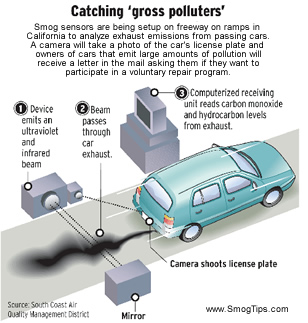
Controlling tailpipe emissions is considered important in the United States and growing around the world except for a few tough holdouts. If the U.S. is so serious about regulating automotive emission controls and controlling tailpipe emissions, why do many states require no testing at all?
Some States have rigorous testing and some only have very basic testing procedures that test tailpipe emissions with the engine at idle, as opposed to running at highway speeds. These engine idle tests might certify that the vehicle exhaust emissions are within the limits set by the local or federal laws even though they may not under road conditions. For 1982 and newer vehicles, Colorado requires a "dyno" test, in which the vehicle is placed on a dynamometer and run at highway speeds as tailpipe emissions are tested.
Colorado has basically done away with safety inspections, which, in my opinion, was a serious mistake, given the condition of some of the barely running wrecks I see on the streets these days.
The Rules for 1982 and Newer Model Year Vehicles
1982 and newer gasoline-powered passenger cars and light duty trucks must be tested every other year as a condition of obtaining a vehicle registration. These vehicles are tested with the enhanced I/M 240 emissions test and can be likened to a treadmill test for your vehicle.
New vehicles do not require an emissions test until the fourth model year. For example, a 2007 model year vehicle is not due for an emissions inspections until 2011. A vehicle being registered in the program area for the first time may be registered without an inspection or certification if the vehicle has not yet reached its fourth model year.
I/M 240 Emissions Test
The I/M 240 tests for carbon monoxide (CO), hydrocarbons (HC) and oxides of nitrogen (NOx) during a simulated driving cycle on a treadmill-like device called a dynamometer; typical driving activities such as idling, cruising, acceleration and deceleration are performed while pollution is collected from the tailpipe.The name of the I/M 240 test means "Inspection and Maintenance, " with 240 representing the length of the treadmill test in seconds (240 seconds, or four minutes). Pollutants are measured in grams per mile (gpm), and emissions limits are set by vehicle type and model year.
Test Process
1. An inspector guides the vehicle into the inspection lane and performs a brief "safety" check, enters the vehicle identification number (VIN) into the computer and makes a visual inspection of required emissions equipment. Customers go to an enclosed waiting area from which they can observe the inspection.
2. The vehicle is positioned with its drive wheels on the dynamometer, allowing it to be tested under actual driving conditions. A fan is positioned in front of the vehicle to simulate wind and keep the engine cool throughout the test. During the driving simulation, emissions are collected from the tailpipe and analyzed. On the basis of emissions data, some very clean vehicles receive a "fast pass" while others have to be tested for the full four-minute cycle. An automatic "second chance" test is provided for vehicles that fail by a small margin. If the vehicle fails within 200% of a pollution limit, the computer will instruct the inspector to run a second test. This is done to minimize the chance that a vehicle might fail simply because of an anomalous situation. For example, the vehicle may fail because it was not sufficiently warmed up.
3. The vehicle is moved off the dynamometer and the gas cap seal test is performed. The customer is given a Vehicle Inspection Report detailing the test results and the inspection fee is collected. If the vehicle passes (and most do) you will be given a "Vehicle Inspection Report" when the emissions fee is collected. If the vehicle fails, you will be provided with a list of local repair facilities ranked by emissions repair success and a computer report providing useful information to assist the repair technician.
All-Wheel Drive/Traction Control Vehicles
Vehicles that are full-time four wheel drive, all-wheel drive or are equipped with traction control are tested using specially-designed dynamometers -- one set for the front wheels and an adjustable set (adjusted based on length of wheel base) under the rear wheels. Each station contains at least one all wheel driver dynamometer and the aforementioned vehicles are tested in this lane. Vehicles that can be shifted from four-wheel drive to two-wheel drive must be tested in two-wheel drive rather than using the four-wheel dynamometers.
Possible "safety" reasons a vehicle could be rejected from testing:
• One or more dashboard warning lights illuminated, such as break light warning, oil light warning, or low coolant warning.
• Defective tires, such as cord showing, uneven wear or temporary spare tire.
• Driver's side door unable to open.
• Inadequate breaking power.
• Vehicle unstable on dynomometer due to a possible alignment problem.
• Vehicle overheating.
• Fluid leak of any kind.
• Clutch or transmission slipping.
Exemptions
The following Colorado motor vehicles are exempt from emissions testing:
• Newly-manufactured vehicles, for the first 4 model years, or until a change of ownership (click here for requirements regarding vehicles being brought into the program area from another state or from another part of Colorado);
• Pre-1975 collector-plated vehicles
• Pre-1942 horseless carriage-plated vehicles
• Vehicles with a two-stroke engine manufactured prior to 1980
• Vehicle registered as "kit" cars
• Motorcycles
• Farm-plated vehicles
• Electric powered vehicles
** Hybrid electric vehicles, such as the Toyota Prius and Honda Insight, and other alternatively powered vehicles do not currently require emissions inspections.
Development of emissions control devices
PCV Valve
Automobile technology manufacturers have been working in the direction of reducing automotive air pollutants since the 1950′s when car tailpipes were found to be part of choking smog in Los Angeles. California established the first standards for automotive emission output in 1967.
The invention of the PCV system or positive crankcase ventilation system was the first step in bringing crankcase fume venting under control. Prior to that crankcase emission were vented to the valve cover and into the air. The PCV system pulled those toxic fumes back into the engine to be re-burned with the air fuel mixture.
One of the next major automobile technology developments was the creation of an air injection system that would help clean up un-burnt hydrocarbons and reduce carbon monoxide by pumping air into the exhaust system soon after the combustion process was completed.
Another big advancement in automotive emission controls was to the fuel we put in the gas tank. Removing lead from gasoline started in around 1970. Removing lead from gasoline brought a lot of benefits. For one thing it eliminates the emission of lead particles from the automobile’s exhaust which was one of the worst byproducts of combustion at the time.
Catalytic Converter
The catalytic converter is probably one of the emission controls that we are most familiar with. The catalytic converter provided a means for oxidizing the CO and HC output in the engine exhaust. Beginning in about 1975 passenger cars and light trucks has been equipped with these catalytic converters.
One of the latest developments would be the evaporative emission control system. Although this is far from new as it has been around since the 70s. This is where fumes from the fuel tank are not allowed to escape into the atmosphere. These fumes are collected and added to the intake charge to be burned in the combustion chamber similar to the way crankcase gases where handled in the late 60′s.
The latest version of this automotive emission controls system has caused problems for many motorists. The federal government decided to make this an integrated system that was capable of notifying the driver and state-level inspection agencies if the system was not working properly. The evap system is tested when the key is turned on by either pulling a vacuum on the system or lightly pressurizing it to test its integrity.
This means if there is a problem with your fuel vapor control system it is quite possible that it will turn on the check engine light. I put together an article about this gas cap code problem on my other website.

No comments:
Post a Comment